
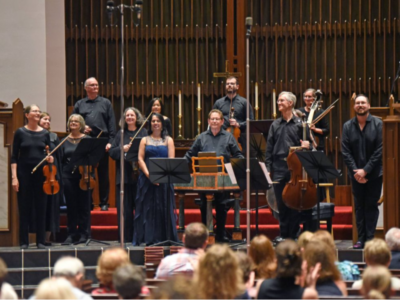
VBT Baroque Ensemble
Music of the eighteenth century is often regarded as irrepressibly square, polite, and witty, but it in fact had many shades, especially in vocal music, which drew upon a dramatic variety of stories. Tales that involved extreme experience—especially pain and suffering—prompted composers to take music beyond conventional boundaries. Wolfgang Mozart, for example, wrote that when an operatic character has an experience that causes him or her to lose a sense of themselves, “the music must no longer know itself.”
Welcome to the outer limits of eighteenth-century musical experience: the fantastic (fantasia), understood then as the imaginary, the supernatural, or the capricious. The realm of fantasia existed beyond the ordinary every-day experience of rational or conventional social (and thus musical) behavior. The four pieces in this concert present different sides of the fantastic, two vocal and two instrumental works.
The first, by Antonio Vivaldi, is the most unorthodox of a collection of flute concertos published as op. 10 in 1728. Titled La notte (“The Night”), it is neither a typical concerto nor a gentle “little night music” serenade. There is very little that is calm about this “night.” Not only is there a lot of activity but, instead of employing the standard three-movement form (fast-slow-fast), this concerto consists of six contrasting vignettes. It seems to follow a dreamer’s fevered imagination from one state to another. This can be gathered from the titles Vivaldi gave two of the movements: the energetic second movement, labelled “fantasmi” (“ghosts” or “spirits,” but also referring to “fantas”[ia]), and the fifth, a very slow, quiet movement called “Il sonno” (“sleep”). This is a bit like the stories portrayed in Vivaldi’s famous “Four Seasons” concertos, but without the accompanying poems that clarify the unpredictable events in the music. Here we are left to use our ‘fantasia,’ to imagine for ourselves what each movement represents.
Alessandro Scarlatti’s cantata Ebra d’amor fuggia was composed in Rome around 1707 during the most productive period in his life for writing cantatas; he eventually produced around 800 of them. This cantata draws on classical mythology: the story of Ariadne, who rescues, falls in love with, and is subsequently abandoned by Theseus, having forsaken her family and homeland for him. Like the Vivaldi concerto, Scarlatti’s cantata involves a dream: the sleeping Ariadne imagines that Theseus is with her. On awaking and finding herself alone, she calls out for the seas to take vengeance on him; unsuccessful, she laments her fate, attracting the attention of the wine god, Bacchus, who pities her and takes her up to the heavens. Like the Vivaldi, the form of the cantata follows Ariadne’s emotional rollercoaster rather than articulating a standard form. This usually involves alternating movements: recitatives (speech-like, as its name suggests), in which a narrator voice relates the events of the story, and da capo arias (songs in ABA form), in which the main character emotes. Here, there is not only a two-movement instrumental introduction, but Ariadne’s speeches dominate. As she gradually breaks down in tears, the movements combine recitative and aria characteristics, and the sense of the key is destabilized by strange chromatic twists and harsh dissonances, as if to represent her mental breakdown. The happy end, where Bacchus takes her up to the heavens, is evoked by a slow lyrical ascent to a stable major key.
The third piece is a concerto grosso by Pietro Locatelli, one of the great travelling virtuoso violinists of his era. As a composer, he wrote music mostly for his own instrument, including “Il pianto d’Arianna” [Ariadne’s lament], published as part of his op. 4 collection of concertos in 1735. It is an instrumental retelling of the same story as Scarlatti’s cantata, and it deploys fantastic musical tropes of emotional instability in unique imaginative ways. These include an unpredictable succession of highly contrasting and evocative short movements in which frenetic activity alternates with languor; highly dissonant and surprising turns of unstable chromatic harmony; and slow movements that mix different kinds of music unpredictably (and imaginatively) as the solo violin takes the role of the lamenting Ariadne in recitative style, accompanied by the other strings.
The last set on the program is drawn from one of George Frederic Handel’s most successful operas for London, Alcina (1735). The plot is drawn from an epic poem, Ludovico Ariosto’s, Orlando Furioso (1532), a mix of romance and military daring-do with a good bit of sorcery and magic thrown in for fun. It was an extremely popular source of opera plots and perfect for fantasia subjects. Alcina is a bad sorceress who turns people to stone or into beasts, including former lovers. She has fallen for the hero, Ruggiero, whom she has seduced by magic. The first of the excerpts is a recitative with orchestral accompaniment (“Ah! Ruggiero crudel!”) that follows Alcina’s changing moods as she cries out to the departing Ruggiero (now freed from his spell) and her unsuccessful attempts to conjure up spirits to assist her. The aria that follows (“Ombre pallide”) is her complaint to the spirits that swirl around her, represented by long strings of fast notes. In the aria “Tornami a vagheggiar,” Alcina tries to convince Ruggiero to stay through vocal charms, rather than magic. In a virtuoso showpiece where the voice exchanges motives with the instruments, Alcina offers Ruggiero musical (and other) pleasures, which the virtuous hero rejects.
Don Fader © 2026